




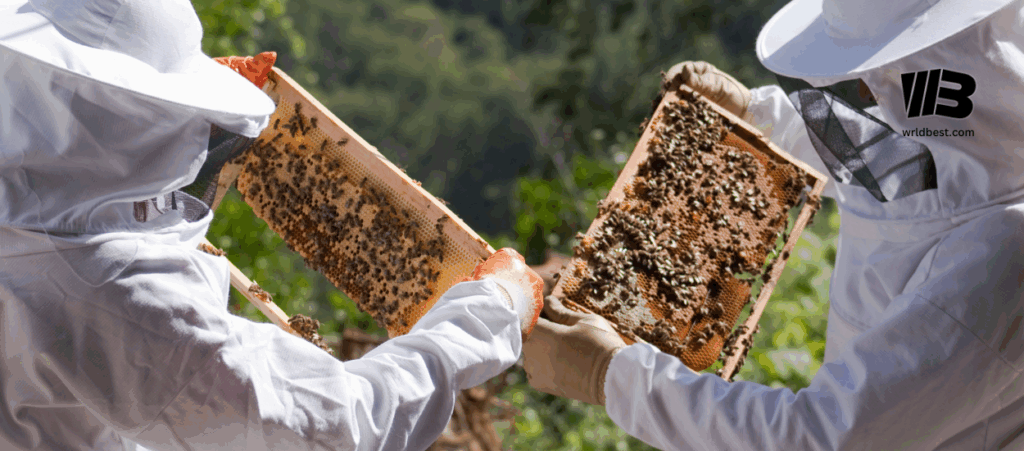
Urban rooftops hum with life as passionate beekeepers transform cityscapes into breathtaking havens for pollinators and biodiversity.
Canada’s cities are buzzing with life—literally. Across the country, a dedicated community of urban beekeepers is transforming rooftops, balconies, and vacant lots into thriving ecosystems that support both bee populations and local communities. These passionate advocates are doing more than just harvesting honey; they’re creating sustainable solutions to pollinator decline, educating the next generation of environmental stewards, and proving that cities can be havens for biodiversity.
From Toronto’s hotel rooftops to Vancouver’s botanical gardens, Montreal’s corporate campuses to Victoria’s family farms, these seven urban beekeeping pioneers are redefining what it means to live in harmony with nature in an urban environment. Their work represents a growing movement that’s sweet for both bees and cities alike.
“Our rooftop apiary isn’t just about honey—it’s a symbol that cities and biodiversity can thrive together. Even in the heart of downtown, we can create habitats that support pollinators.”
Melanie Coates – BEEGrrl & Fairmont Royal York
Melanie Coates made headlines when she helped establish Toronto’s first hotel rooftop apiary at the prestigious Fairmont Royal York, transforming an underutilized urban space into a thriving bee habitat in the heart of downtown. Her innovative approach to urban beekeeping has not only produced exceptional honey but has also created a model for how luxury hospitality can embrace sustainability. The rooftop apiary has become a symbol of Toronto’s commitment to urban biodiversity, demonstrating that even the busiest city centers can support pollinator populations.
Beyond her work with the Fairmont, Melanie operates BEEGrrl, a specialized urban bee shop that serves as both a resource center and educational hub for aspiring urban beekeepers. Through BEEGrrl, she provides everything from locally-sourced honey to expert hive consultation and essential beekeeping supplies, making urban beekeeping accessible to Toronto residents who want to contribute to the city’s ecological health. Her collaboration with organizations like FoodShare has extended her impact beyond individual beekeepers to community-wide food security initiatives.
Check out their website and LinkedIn for more information.
Julia Common – Bees Actually
Julia Common brings both scientific rigor and community passion to Vancouver’s urban beekeeping scene as a certified instructor and BC Regional Director of the Western Apicultural Society. Her journey began as co-founder of Hives for Humanity, a groundbreaking organization that combined beekeeping with social impact by providing training and employment opportunities to individuals facing barriers to traditional employment. This innovative approach demonstrated how urban beekeeping could address multiple social challenges simultaneously, from environmental conservation to community development.
Now leading Bees Actually, Julia has shifted her focus toward bee health research and advanced education, positioning herself at the forefront of solving the complex challenges facing urban bee populations. Her work combines cutting-edge research with practical applications, helping urban beekeepers understand and address issues like disease management, seasonal adaptation, and sustainable hive practices. Through Bees Actually, she continues to train the next generation of urban beekeepers while contributing valuable research that benefits the broader beekeeping community across Canada.
Check out their website and LinkedIn for more information.
Brian Campbell – Blessed Bee Apiaries & Bee School
Brian Campbell has achieved the prestigious designation of Master Beekeeper, a credential that reflects his deep expertise and commitment to advancing beekeeping practices in urban environments. His role as an instructor at both UBC Botanical Garden and KPU Farm School positions him at the intersection of academic research and practical application, where he trains students and community members in sustainable beekeeping practices. His location at UBC Botanical Garden provides an ideal setting for demonstrating how urban beekeeping can complement botanical conservation efforts and support campus sustainability initiatives.
Through his Blessed Bee Apiaries & Bee School, Brian has created a comprehensive educational platform that goes beyond basic beekeeping techniques to address broader issues of pollinator conservation and ecosystem health. His curriculum covers everything from hive management and bee biology to the crucial role of pollinators in urban food systems. Brian’s approach emphasizes the scientific understanding of bee behavior and ecology, helping his students become not just beekeepers but advocates for pollinator conservation who can make informed decisions about urban environmental management.
Check out their website for more information.
Lindsay Dault – Country Bee Honey Farm
Lindsay Dault’s journey in urban beekeeping began with the founding of Urban Bee Supplies, where she became a cornerstone of Vancouver Island’s beekeeping community by providing essential equipment, education, and support to aspiring urban beekeepers. Her transition from equipment supplier to hands-on beekeeper reflects her deep commitment to the craft and her desire to lead by example. As a Master Beekeeper, Lindsay brings both technical expertise and practical experience to her current role, having witnessed firsthand the evolution of urban beekeeping practices and the challenges faced by city-based apiaries.
“Urban beekeeping isn’t just a hobby—it’s an essential part of creating sustainable, self-sufficient cities that respect nature.”
Now co-managing Country Bee Honey Farm on the Saanich Peninsula with approximately 80 hives, Lindsay has scaled her operation while maintaining her focus on education and community support. Her farm serves as both a production facility and a learning center, where she teaches certified courses that combine traditional beekeeping wisdom with modern urban adaptations. Lindsay’s unique perspective, gained from both her retail experience and hands-on beekeeping practice, makes her an invaluable mentor for urban beekeepers who need to navigate the complexities of maintaining healthy hives in city environments while building sustainable local honey businesses.
Check out their website for more information.
Alexandre Mclean – Alvéole
Alexandre Mclean co-founded Alvéole with a vision that extends far beyond traditional beekeeping, creating a social enterprise that installs and maintains urban hives in workplaces, schools, and community centers across Canada. His innovative business model addresses the practical barriers that prevent organizations from starting their own beekeeping programs by providing turnkey solutions that include hive installation, maintenance, and educational programming. This approach has enabled dozens of schools and businesses to incorporate beekeeping into their sustainability initiatives without requiring internal expertise or significant resource allocation.
Alvéole’s impact reaches beyond honey production to encompass comprehensive ecological education programs that raise awareness about pollinator conservation and environmental stewardship. Alexandre’s workshops and educational sessions have reached thousands of participants, from elementary school students learning about bee lifecycles to corporate teams discovering the connections between urban biodiversity and business sustainability. The organization’s success in Montreal has served as a model for expansion across Canada, demonstrating how urban beekeeping can be scaled through partnerships with institutions that share commitments to environmental responsibility and community education.
Check out their website and LinkedIn for more information.
Fran Freeman – Independent Urban Beekeeper
Fran Freeman represents the grassroots spirit of urban beekeeping, operating multiple apiaries throughout Toronto while pursuing an ambitious long-term project to develop a “Toronto bee” strain adapted specifically to the city’s unique environmental conditions. Her background in sustainable agriculture, gained through the University of Guelph’s programs, provides her with the scientific foundation to approach urban beekeeping as both an art and a science. This combination of formal education and hands-on experience allows her to experiment with breeding and hive management techniques that other urban beekeepers can learn from and adapt to their own situations.
Fran’s work with strain development addresses one of the most significant challenges facing urban beekeeping: creating bee populations that can thrive in city environments with their unique combination of stressors and resources. Her multi-apiary approach allows her to observe how different microclimates and neighborhood characteristics affect bee health and productivity, generating valuable data that contributes to the broader understanding of urban pollinator ecology. Through her independent practice, Fran embodies the entrepreneurial spirit that drives much of Toronto’s urban beekeeping community, proving that individual beekeepers can make significant contributions to both local ecosystems and the scientific understanding of urban pollinator conservation.
Check out their LinkedIn for more information.
Oliver Couto – The Bee Shop
Oliver Couto has established The Bee Shop as Toronto’s premier destination for urban beekeeping education and supplies, creating a comprehensive resource that serves both novice and experienced beekeepers throughout the GTA. His role as principal beekeeper and instructor allows him to offer hands-on learning experiences that are rare in urban environments, including rooftop apiary tours that give participants direct exposure to active hives and real-world beekeeping practices. These tours have become increasingly popular as more Torontonians seek to understand the role of pollinators in urban ecosystems and explore sustainable hobbies that benefit their communities.
The Bee Shop’s programming extends beyond traditional beekeeping education to include creative workshops like candle-making using natural beeswax, which helps participants appreciate the full range of products that come from healthy hives. Oliver’s introductory courses are designed specifically for urban environments, addressing unique challenges like limited space, neighbor relations, and seasonal management in city conditions. His approach makes beekeeping accessible to apartment dwellers and homeowners alike, often leading to the establishment of community apiaries and shared hive ownership models that strengthen neighborhood bonds while supporting local pollinator populations.
Check out their LinkedIn for more information.
Conclusion
These seven urban beekeepers represent more than individual success stories—they’re part of a growing movement that’s transforming how Canadian cities think about biodiversity, sustainability, and community engagement. Through their diverse approaches, from luxury hotel apiaries to educational nonprofits, corporate partnerships to independent research projects, they’re proving that urban environments can support thriving pollinator populations while providing meaningful opportunities for environmental education and community building.
Their collective work addresses critical challenges facing both urban environments and bee populations, creating solutions that benefit entire ecosystems while engaging citizens in hands-on environmental stewardship. As cities across Canada continue to grow and evolve, these beekeeping pioneers are showing us that the future of urban living can be both sustainable and sweet—one hive at a time.
To get even more inspiration check out 7 Small Businesses in NYC Revolutionizing Sustainable Fashion with Zero Waste and 5 Local Boutiques in Montreal Bringing Unique Home Decor Designs to Life.


























Leave a Comment
Your email address will not be published. Required fields are marked with *