

Today’s fashion isn’t just about aesthetics—it’s about ethics, creativity, and emotional connection. A growing number of designers are turning to what others throw away.
When I was a child, my grandmother used to mend clothes with fabric scraps from old curtains or flour sacks. To me, it wasn’t just sewing—it was storytelling. A jacket lining might hold the memory of her wedding tablecloth, while a patch on a pair of jeans once hung in her kitchen window. It taught me that the objects we touch daily carry meaning. And when we repurpose them—when we wear them—we’re not just dressing ourselves; we’re wrapping ourselves in memory, intention, and care – this is wearable art.
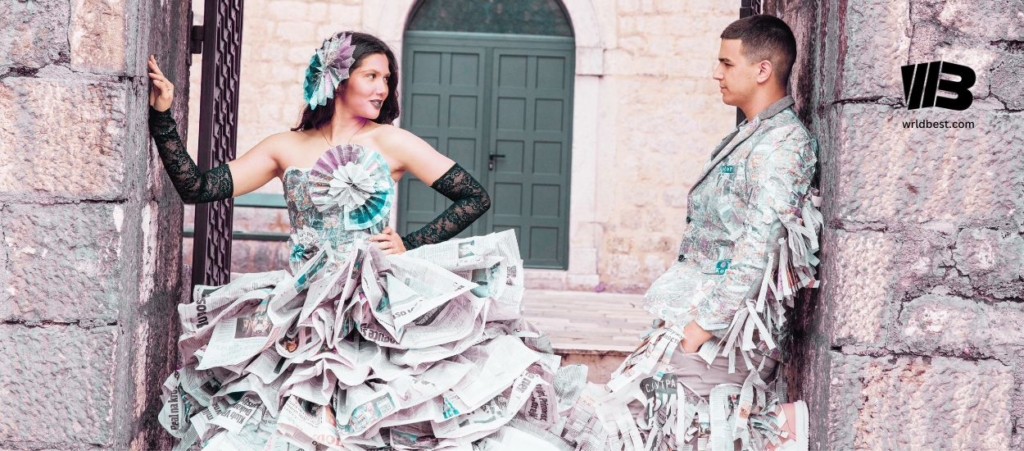
Today’s fashion isn’t just about aesthetics—it’s about ethics, creativity, and emotional connection. A growing number of designers are turning to what others throw away—everyday items like plastic, packaging, broken tools, and forgotten fabrics—and transforming them into powerful pieces of wearable art. These creations don’t just challenge our definition of beauty. They offer sustainable solutions and emotional resonance, proving that fashion can heal, inspire, and reconnect us to the world around us. Here are five designers who are crafting more than garments—they’re crafting new ways of seeing.
1. Nicole McLaughlin – USA
“Upcycling is so cool because a jacket doesn’t have to stay a jacket, it could be anything else.”
Nicole McLaughlin is one of the most influential names in the upcycled fashion movement. Based in New York, she has become known for transforming everyday, often discarded objects into functional and wearable garments. A volleyball becomes a shoe. A packet of ketchup morphs into a pocket. Her pieces are clever, playful, and often comically exaggerated—but beneath the humor is a very real message about overconsumption and waste. Nicole’s work encourages us to question why we throw away so much, and what it would mean to instead see potential in what we overlook.
More than just a designer, Nicole is also a mentor and educator. She regularly shares tutorials, process videos, and sustainability insights across her social media platforms to demystify the design process and empower others to start creating themselves. In a world overwhelmed by fast fashion, Nicole’s ethos feels refreshing: thoughtful, personal, and full of heart. Her wearable art reminds us that creativity is a powerful antidote to waste—and that reinvention is always possible.
2. Lisa Walker – New Zealand
Lisa Walker’s jewelry doesn’t follow the rules. It disrupts them. Known for using materials like plastic cutlery, carpet remnants, and children’s toys, Lisa’s pieces are not conventionally beautiful—but they are deeply expressive. Based in New Zealand, she challenges her audience to reconsider their perceptions of value and aesthetics. What makes something “jewelry”? Why do we only find meaning in precious metals and gemstones? Her pieces spark questions more than they provide answers, encouraging a more mindful relationship with objects.
Lisa’s work is exhibited in museums and galleries across the globe, not only because of its bold visual impact but because of its philosophical depth. In each creation, there’s a quiet insistence: that the mundane holds meaning, that imperfection is worthy of admiration, and that wearable art can speak directly to the complexities of life. Her pieces don’t just accessorize—they provoke thought, challenging the wearer to see themselves and their surroundings with new eyes.
3. Jay Sae Jung Oh – South Korea / USA
“I want to make people a little more appreciative of what they have, instead of always looking for something new.”
Jay Sae Jung Oh’s work stands at the intersection of sculpture, sustainability, and design. In her “Salvage” series, she collects discarded items—old electronics, plastic toys, household tools—and meticulously wraps them in raw leather cords. The result is a collection of stunning, monolithic forms that feel both ancient and futuristic. While her designs are more commonly displayed as furniture, many have inspired accessories and wearable statements that reinterpret utility as elegance.
What makes Jay’s work particularly compelling is its dual nature: it’s both a critique of consumer culture and a celebration of craftsmanship. Each piece takes months to complete, and every cord is hand-wrapped, turning forgotten items into objects of reverence. In a disposable world, her creations ask us to slow down, to care more deeply, and to see the things we discard as pieces of our shared story. Her vision is less about adornment and more about emotional restoration through design.
4. Tatty Devine – UK
Tatty Devine, founded by Rosie Wolfenden and Harriet Vine, is a British brand that specializes in laser-cut acrylic jewelry with a distinctly playful twist. Their pieces are bold, colorful, and often humorous—think necklaces shaped like bananas, book covers, or musical instruments. But their materials are rooted in repurposing and minimal waste. They work with recycled acrylic and create everything in-house in their London studio, ensuring ethical labor and full transparency.
What sets Tatty Devine apart is its commitment to joy as a design principle. In a world where fashion can often feel inaccessible or overly serious, Tatty Devine invites everyone to participate. Their designs tell personal stories—some nostalgic, some whimsical, all deeply human. They believe that fashion can be inclusive, expressive, and emotionally healing. Wearing one of their pieces doesn’t just brighten your outfit—it brightens your spirit.
5. Clarissa Knighten – USA
Clarissa Knighten creates jewelry that breathes life into forgotten things. Buttons, bike chains, sea glass, scrap leather—she assembles each element with intuitive precision, transforming them into pieces that are both striking and soulful. Based in Kansas City, her work is rooted in resilience. For Clarissa, each creation is a form of therapy—a reflection of her journey through depression, recovery, and creative rebirth.
Clarissa’s work carries a message of transformation. It tells wearers and viewers alike: nothing is wasted. Nothing is broken beyond repair. By combining natural and industrial materials, her jewelry becomes a metaphor for the complexity of the human experience. Her work doesn’t just celebrate the beauty of upcycling—it honors survival, reclamation, and self-love. For those who wear her art, it becomes a kind of armor: beautiful, bold, and brimming with meaning.
Conclusion
These five designers show us that what we discard can become what we cherish. In their hands, broken tools, plastic scraps, and forgotten objects are reimagined into powerful statements—about sustainability, about value, and about what it means to wear something meaningful. Their work is a quiet revolution against waste and a tender reminder that beauty is everywhere, waiting to be seen, waiting to be wearable art.
In a world overwhelmed by fast fashion and disposability, their designs offer something deeper: a path back to connection. With each piece, they invite us to slow down, look closely, and choose with care. Because when we wear something made from love, intention, and imagination—we carry more than art. We carry stories.
If you liked this article, be sure to read 7 Fashion Boutiques Blending Heritage with Modern Design and This Thrift Store is Fashioning the Future by Combating Fast Fashion in Tucson.

























Leave a Comment
Your email address will not be published. Required fields are marked with *